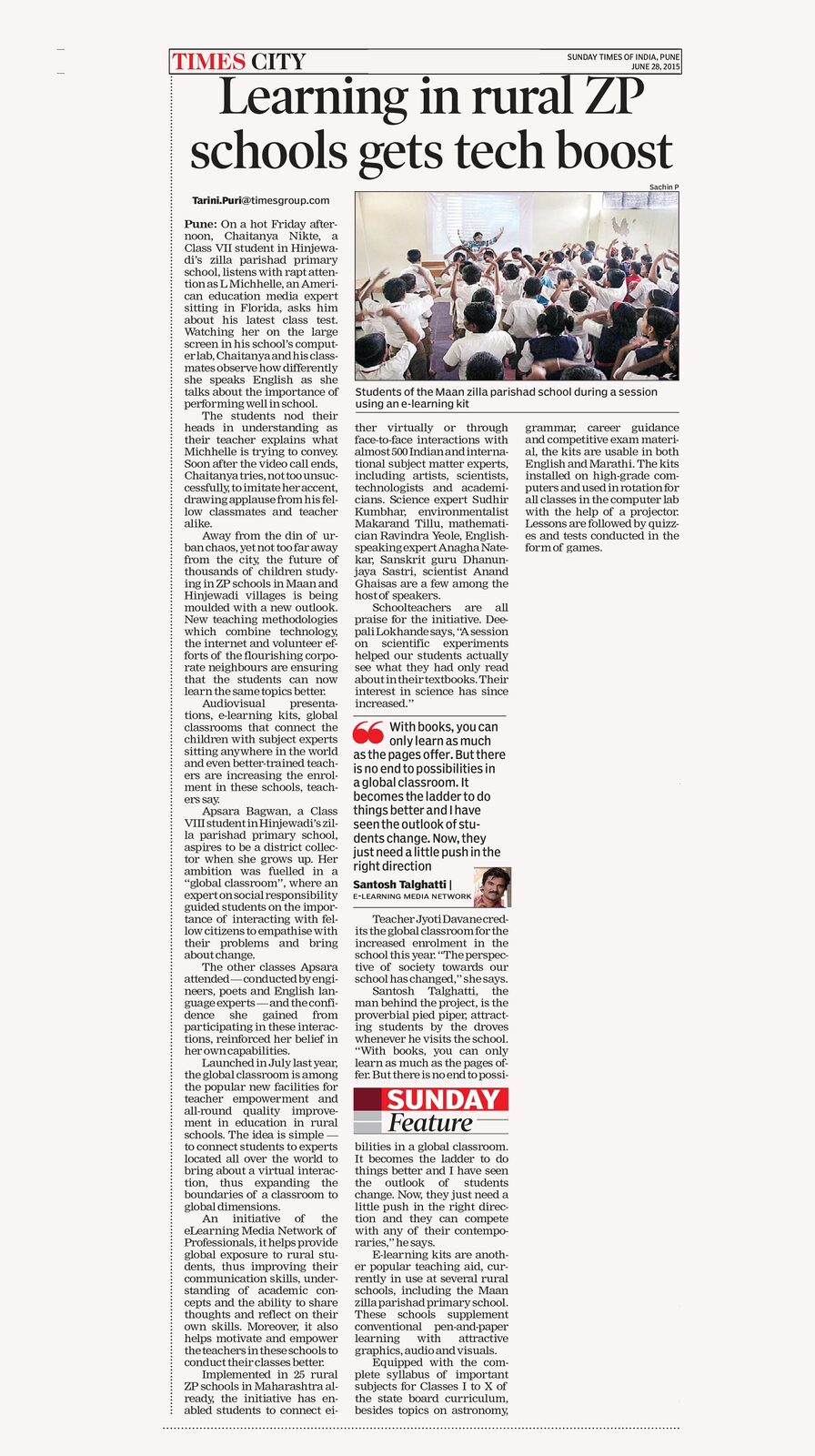
The Times of India covered the Global Classroom's first Maharashtra rollout in Maan and Hinjewadi Zilla Parishad schools — students taking video calls with international experts, e-learning kits in daily use, and enrollment climbing as word spread through the villages.
Teacher Jyoti Davane, quoted in the piece, put it simply: “The perspective of society towards our school has changed.” Headmistress Deepali Lokhande added that a single science session on real experiments “helped our students actually see what they had only read about in their textbooks.”
Reproduced from the print edition for reference; full rights remain with The Times of India.
These figures reflect what the first chapter of eLMNOP achieved. As we reopen, they're the baseline we're rebuilding from — not a current live count.
Schools reached in Maharashtra
Educators engaged worldwide
Interns & global experts
Villages identified with demand
Villages: Hinjewadi, Maan, Sutarwadi, Botarwadi
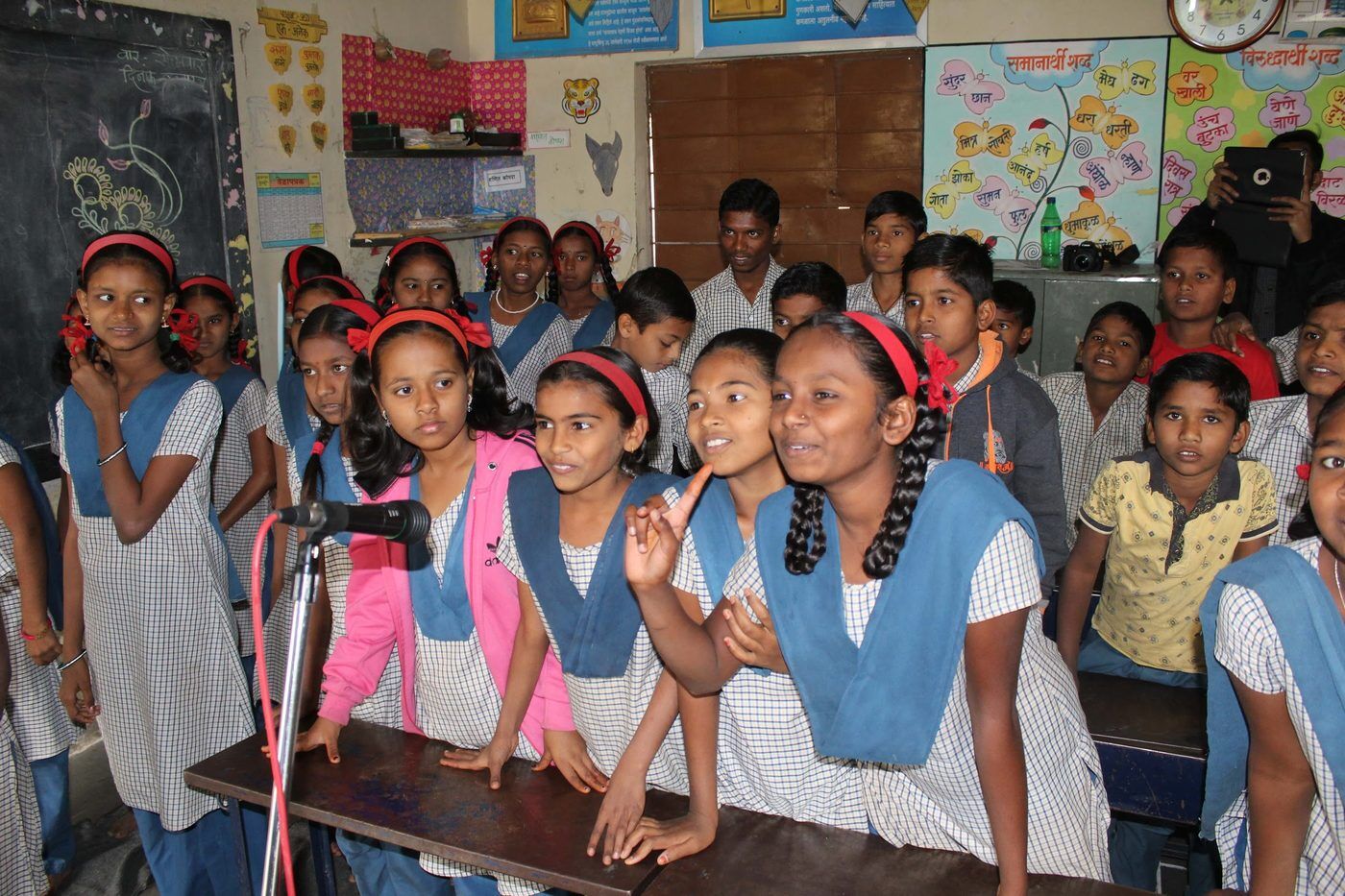
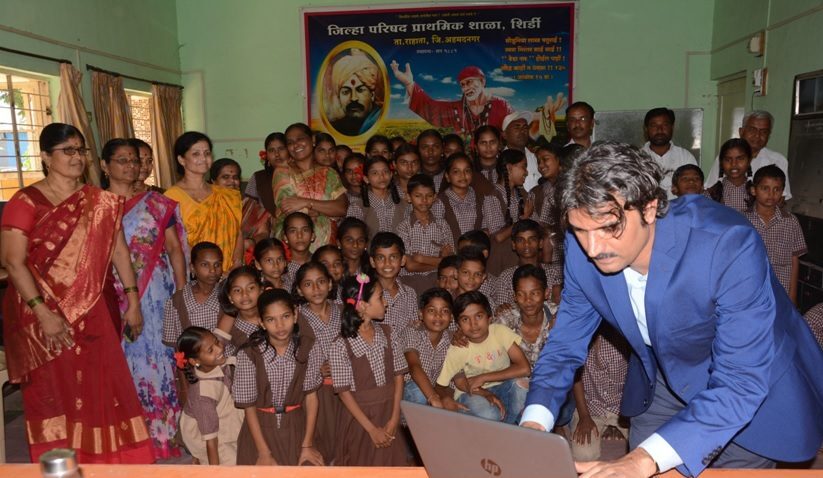
An initial survey identified the real barriers on the ground: teachers with little computer knowledge, no awareness of e-learning resources, a narrow set of teaching aids, and real apprehension about using new technology or activity-based methods. Students, meanwhile, had almost no hands-on time with computers at all — and the machines that did exist were often broken, with no one around who knew how to fix them.
Rather than treating this as a hardware problem, eLMNOP treated it as a village-development problem. Santosh Talaghatti and eLMNOP's global expert network worked with the Sarpanch, the school Principal, and the Village Development Officer to build local buy-in before a single machine arrived. Corporate CSR partners — including Cognizant, which supplied 10 high-configuration PCs — funded the hardware; a dedicated e-Lab was built for audio-visual interaction; and internet providers were brought in to solve the connectivity problem directly.
Mulshi Taluka isn't a one-off — it's the template. The same six-step process is what eLMNOP is built to repeat across the 1,500 villages already identified as ready for a Global Classroom.
“Global Classroom program was implemented in 5 Zilla Parishad Schools in Mulshi Taluka. Computers, advanced technology and Global Classroom programs have helped students practically view informative and educative programs from worldwide. It has inspired not only rural students but also teachers towards a new hope in education and learning.”
“First of all we are highly grateful for implementing the Global Classroom Program with our school. Your program has helped our students interact online with many experts so far. This is a very effective and joyful experience.”
“I have known Santosh Talaghatti, pioneer of Global Classrooms, over the last two years. Not only did he have an in-depth knowledge and understanding of issues in hardware and software, but he has the ability to grasp the needs, conceptualize the hurdles, and develop an overall solution that meets the requirements.”
“I am beyond excited about the progress we have made with the Global Classroom initiative. It has changed the way students in distant countries relate to educators and experts in other nations — such a tremendous language exchange, and so inspirational.”
“Who is able to master his values with a high-quality sense of perceiving and acting, with respect for society and non-traditional, revolutionary ideas — simply capable of breaking the boundaries of the accepted norm. That is exactly what Santosh Talaghatti is.”
“Inspiring educationists at various levels, exciting the imagination of politicians, and raising the interest of industrialists. This will put India at the forefront of one of the world's leading educational movements, for such a great population.”
Every Global Classroom we've built started with a partner willing to fund hardware, connectivity, or teacher training — this is how that partnership works, in practice.
Cognizant provided 10 high-configuration PCs for a pilot school under the Digital India School initiative — hardware that directly enabled the Mulshi Taluka results.
Government support has also played a role at the local level, with engagement from Gram Panchayats, Zilla Parishads, and Education Officers helping clear the path for implementation.
Concrete infrastructure, not an abstraction — this is what a CSR partnership funds per school.
| Processor | Intel Core i5 / i7 |
| RAM | 8 GB DDR3+ |
| Storage | 500 GB–1 TB HDD |
| Display | 15.6″ LED screen |
| Connectivity | WiFi, Bluetooth, HDMI, USB |
| Built-in | HD webcam & microphone |
Fund a full Global Classroom rollout: hardware, connectivity, and teacher training.
Fund the hardware and setup for a dedicated audio-visual learning space.
Fund the ICT and pedagogy program that turns hardware into real outcomes.
Join our network of global experts who run live sessions with students.