Bring a Global Classroom to your school — we'll walk you through school selection, community buy-in, and setup.
Enroll your schoolTeach a session, mentor a student, or join our Global Classroom Facilitator Training track.
Volunteer with usFund a village, an e-Lab, or a teacher — see the four partnership models on the Impact & Partners page.
Start a partnershipSearch for volunteer opportunities based on your subject, interests, and nearest location to a school. If your workplace runs an employee-volunteering program, we can help your colleagues share their knowledge with students online in their free time.
Deliver a self-paced, web-based session on a subject you know well — fun, practical, and easy to understand. You schedule the time; we handle the classroom on the other end.
Whatever you're passionate about — drama, dance, a special computing or artistic skill, music, or physical education — bring it to a classroom in person and make it something special for the students.
Technology-based education is the bridge to a brighter future for every child. Contribute directly toward tuition fees, school bags, or stationery for students who need it.
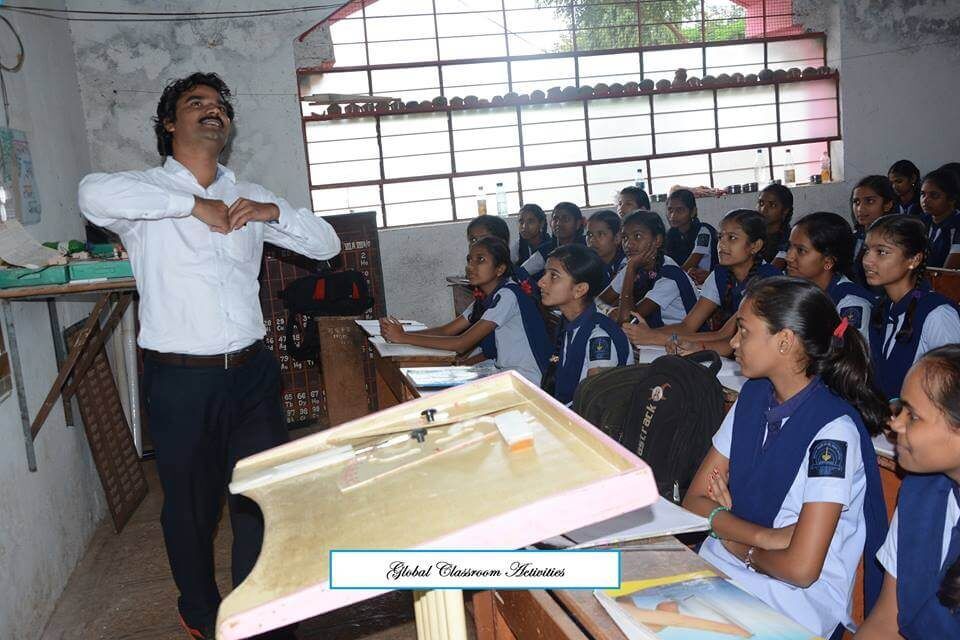
India's cities have digitized education; that progress stops almost entirely at the edge of Tier 3 and 4 India, where roughly 6,38,000 towns and villages sit largely untouched.
At eLMNOP, we didn't discover this gap in a report — we found it school by school, starting in villages like Hinjewadi, Maan, Sutarwadi, and Botarwadi in Mulshi Taluka. An initial survey there found a consistent pattern: teachers with little to no computer knowledge, no awareness of the e-learning tools already available to them, and a real, understandable apprehension about replacing familiar teaching methods with unfamiliar technology. Students, for their part, had almost no hands-on time with a computer at all.
This is the actual shape of India's digital divide. It isn't a lack of ambition — India's national education policy already lists digital literacy and bridging the digital divide as explicit priorities. It's a lack of a repeatable way to get technology, training, and community buy-in into a single rural school at the same time.
That's what the Global Classroom Initiative is built to solve. It starts with the school and the village, not the hardware: meeting the Sarpanch, the Principal, and the Village Development Officer before a single machine arrives, because a school only accepts new technology when the community understands why. From there, CSR partners and government support fund the actual e-Lab, connectivity is secured, and — critically — teachers are trained and re-trained until using the tools feels normal rather than risky.
The results are not hypothetical. In the Mulshi Taluka pilot, student enrollment rose to 500, and every teacher in the cluster now has working computer literacy — using it daily for records, email, and lesson planning.
There are 1,500 more villages where we've identified the same demand. The gap isn't going to close itself. It closes one school, one CSR partnership, and one trained teacher at a time.
The hardest part of digital education isn't hardware or connectivity — it's the moment a teacher who's taught the same way for twenty years is handed a laptop and asked to trust it.
Before the Global Classroom Initiative reached the villages of Mulshi Taluka, that trust didn't exist. Teachers had limited exposure to teaching aids or practical experiments, used a narrow set of conventional methods, and were, in many cases, genuinely apprehensive about activity-based or technology-driven teaching. That apprehension is not a character flaw — it's a rational response to being asked to change a working system with no support in place if it breaks.
So our teacher training program doesn't start with "here's your new computer." It starts with an awareness program: what the Global Classroom is, why it exists, and what it changes for the teacher personally — not just for the students. Only after that groundwork does the ICT training begin, covering interactive teaching methods, continuous comprehensive evaluation, co-curricular activity design, and — just as importantly — basic repair and troubleshooting, so a broken machine doesn't mean a dead classroom for a week.
The shift, when it happens, is visible and specific. Teachers in our program now use computers to manage attendance and marks. They use email regularly to communicate with peers at other schools. They browse the internet independently, bookmarking resources they'll use later. Most tellingly, they've started experimenting with new methods in their core subjects — not because we told them to, but because the fear that used to block that experimentation is gone.
This is why eLMNOP treats teacher training as the actual product, not an add-on to hardware delivery. A fully-equipped e-Lab with an untrained, unconvinced teacher standing in front of it changes nothing. A trained, confident teacher — even with modest equipment — changes everything downstream.
When women and girls receive real educational opportunities, they gain greater ability to generate income, their families become healthier, and child marriage rates fall.
It's easy to talk about girls' education in purely values-driven terms — fairness, equality, the right to learn. Those things are true. But they're also not the whole argument, and reducing it to sentiment undersells how directly this investment pays off.
The evidence is specific: when women and girls receive real educational opportunities, they gain greater ability to generate income, their families become healthier, and they tend to have fewer children while marrying at older ages — directly reducing rates of child marriage. The downstream effects extend further still, touching poverty reduction, lower inequality, better health outcomes, reduced crime, and measurably less gender-based violence.
That's precisely why eLMNOP built a dedicated Girls & Women Empowerment strand into the Global Classroom model rather than treating it as a footnote to general digital education. It runs as individual and group life-coaching sessions, structured training meetings, and self-development programs — designed around the specific barriers girls face in rural Indian communities.
We've seen what happens when a rural classroom stops treating girls' education as optional. It isn't a side effect of our program — for many of the 1,500 villages we've identified, it's the reason the community says yes to the Global Classroom at all.
eLMNOP is recognized as a startup by India's Department for Promotion of Industry and Internal Trade (DPIIT), Government of India — Certificate No. DIPP9196, incorporated 20 May 2013.
DIPP Certificate No. DIPP9196 · Private Limited Company, incorporated 20-05-2013.
Also featured in the Sunday Times of India, Pune (28 June 2015) — “Learning in rural ZP schools gets tech boost.”
Additional press clippings and brochures will be added to this section as they're gathered.
Three quick paths, or the full enquiry form below — whichever fits what you need.
Santosh Talaghatti, Founder of eLMNOP — and the guidance of his mentor and guru, Sanyasi Baba, behind today's reopening.
Meet Santosh & AnA JiFull school details, infrastructure readiness, and program interest — one dedicated registration form.
Register Your SchoolFund a village, an e-Lab, or a teacher-training cohort — tell us your focus area and budget below.
Start a CSR RequestSantosh Talaghatti
LocationPune, Maharashtra, India
Phone Emailsantosh.talaghatti@gmail.com
santosh@digitalindia.school
eLMNOP Innovative Education and Research Pvt. Ltd.
DIPP-recognized Startup (Certificate No. DIPP9196)
See the four partnership models — village adoption, e-Lab funding, teacher training sponsorship, and Global Classroom hardware — on the Impact & Partners page.